

Indoor air quality complaints are among the most common reasons workers reach out to OSHA — and most employers are surprised to learn that OSHA does not need a dedicated air quality regulation to act on those complaints.
That distinction matters more than most people realize.
The Symptoms Come First
Workers rarely start by thinking about HVAC systems or ventilation rates. They start by not feeling well. Headaches that clear up on weekends. Fatigue that hits hard by mid-afternoon. Itchy eyes, scratchy throats, or that low-level nausea that gets blamed on everything except the building itself.
Musty odors. Chemical smells that linger hours after the cleaning crew has gone. Worsening asthma in people who had it mostly under control at home.
When those symptoms cluster — when three, four, five people in the same wing of an office or school report the same things — OSHA pays attention.
What Usually Causes It
Poor HVAC maintenance is the most commonly cited factor in workplace air quality complaints, and for good reason. Filters that go unchanged, coils that go uncleaned, and systems that are simply undersized for the building they serve create conditions where contaminants build up rather than clear out.
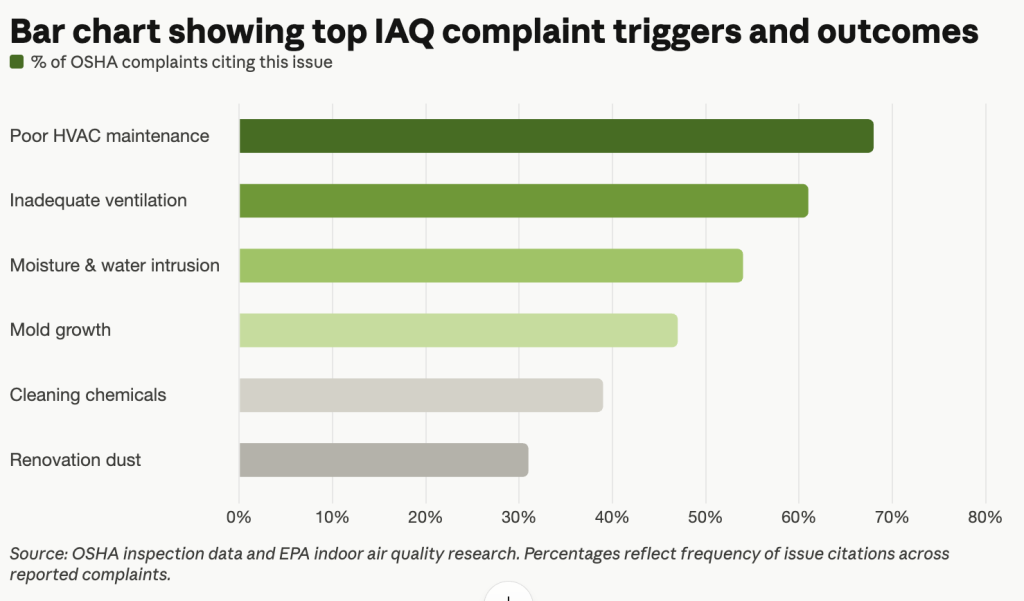
Water intrusion is another frequent culprit. A slow roof leak, a condensation problem, a pipe that sweated through a summer without anyone noticing — moisture finds its way into walls and ceilings, and mold follows. Renovation and construction dust, cleaning chemicals with heavy fragrances, and flat-out inadequate fresh air exchange round out the list of what investigators most often find.
Ed Karl, owner of Karl Environmental Group, puts it plainly: “Most of the air quality cases I’ve walked into were preventable. The building was sending signals for months — odors, staining, occupant complaints — and management treated them as isolated nuisances rather than a pattern worth investigating. By the time OSHA arrived, the problems were significant and the documentation trail was damaging.”
How OSHA Gets Involved
The path to an OSHA investigation often starts with a single formal complaint, though repeated informal reports from workers can produce the same result. An investigation typically means requests for HVAC inspection and maintenance records, a walkthrough of the building, and sometimes third-party air quality or mold testing.
The legal basis for all of this is the General Duty Clause, which requires employers to maintain a workplace free from recognized hazards that are reasonably likely to cause harm. Poor indoor air quality — especially when workers have documented health complaints — qualifies as exactly that kind of hazard.
The Cost of Doing Nothing
Ignoring air quality concerns does not make them go away. It makes them harder and more expensive to address later.
An OSHA inspection disrupts operations. The investigation process is time-consuming. Employee concerns tend to escalate rather than settle down when they feel management has dismissed them. Productivity and morale in buildings with known air quality problems drop in ways that show up in attendance and retention data.
Ed Karl adds: “Proactive evaluation is almost always less expensive than reactive enforcement. A qualified assessment might cost a few thousand dollars. A drawn-out OSHA investigation, legal exposure, and the cost of emergency remediation can run ten times that.”
The Bottom Line
You do not need a specific OSHA air quality standard to face an OSHA problem. A pattern of employee health complaints is enough to open a door you would rather keep closed.
Addressing air quality concerns early — investigating complaints, maintaining HVAC systems, bringing in qualified assessors when something seems off — protects workers, reduces liability, and keeps operations running without disruption.
FAQs
Q: How do I know if my building has an indoor air quality problem?
The most reliable early signal is a pattern. One employee with a headache is easy to dismiss. Four employees in the same area reporting headaches, fatigue, or respiratory irritation regularly is something worth investigating. Other signs include persistent musty or chemical odors, visible moisture staining, and complaints that seem to improve when people leave the building and return when they come back. Karl Environmental Group conducts building assessments that identify the source of these patterns before they escalate into a formal complaint or an OSHA investigation.
Q: Do I need to wait for an OSHA complaint before addressing air quality concerns?
No, and waiting is almost always the more costly choice. By the time a formal complaint is filed, the problem has typically been developing for months. An early assessment gives you the information you need to make corrections on your own timeline, with your own contractors, at a fraction of the cost of emergency remediation. Karl Environmental Group works with building owners and facility managers who want to get ahead of problems rather than react to them.
Q: What does an indoor air quality assessment actually involve?
A professional assessment goes well beyond a visual walkthrough. It typically includes a review of HVAC maintenance records, air sampling for contaminants, moisture and mold evaluation, and a written report with specific findings and recommended corrective actions. The goal is not just to identify what is wrong but to give you a clear, actionable path forward. Karl Environmental Group provides assessments tailored to the size and use of your facility, whether that is a medical office, a school, or a commercial building with multiple tenants.