
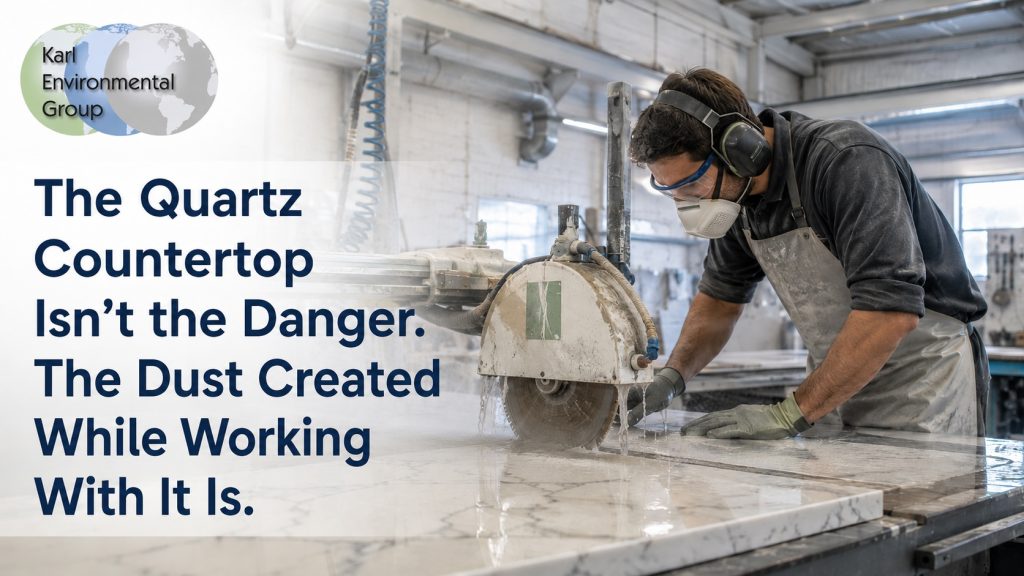
A beautiful quartz countertop sitting in a finished kitchen isn’t the concern.
The danger can happen long before the homeowner ever sees it.
When engineered stone is cut, ground, polished or drilled, extremely small particles of crystalline silica can become airborne. Workers may not be able to see that dust, but they can breathe it deep into their lungs.
And a recently published report shows just how serious exposure to countertop silica dust can become.
From January 2019 through June 2026, the California Department of Public Health identified 592 cases of silicosis among workers who fabricated engineered-stone countertops.
Of those workers:
- 65 underwent lung transplants
- 31 died
- The median age at diagnosis was only 46
The findings, published in August 2026, add to growing concern about silica exposure among workers who manufacture, finish and install engineered-stone countertops.
While these particular cases were documented in California, silica exposure is not just a California issue.
It is a workplace safety concern for employers and workers across the country.
Why Is Engineered Stone a Concern?
Engineered stone is frequently marketed simply as “quartz.”
It has become extremely popular for kitchen countertops, bathroom vanities and other surfaces because of its appearance, consistency and durability.
But the material can also contain very high concentrations of crystalline silica.
According to updated guidance from the Occupational Safety and Health Administration (OSHA) and the National Institute for Occupational Safety and Health (NIOSH), some engineered-stone products can contain as much as 95% crystalline silica.
The silica contained inside a finished countertop isn’t the primary exposure OSHA and NIOSH are warning about.
The concern develops when the material is disturbed.
Activities such as:
- Cutting,
- Grinding,
- Drilling,
- Polishing,
- Edging,
- Shaping,
- and Finishing
can release respirable crystalline silica into the air.
These particles can be so small that workers may not even realize they’re breathing them.
What Happens When Silica Dust Is Inhaled?
Respirable crystalline silica particles are small enough to travel deep into the lungs.
Repeated or significant exposure can cause silicosis, an irreversible lung disease involving inflammation and permanent scarring of lung tissue. Silicosis can make breathing increasingly difficult and may continue progressing even after a worker is no longer exposed.
Silica exposure has also been associated with other serious health concerns, including lung cancer, chronic obstructive pulmonary disease, kidney disease, tuberculosis and certain autoimmune conditions.
What makes the recent engineered-stone cases particularly troubling is the age of the workers affected and the severity of their disease.
The median age at diagnosis among the 592 California workers was only 46.
These aren’t necessarily diseases appearing decades after someone has retired.
Workers can become seriously ill while they are still in the workforce.
An Important Distinction for Employers
There is an important point that can easily get lost when people hear about “dangerous quartz countertops.”
The installed countertop itself is not the exposure OSHA and NIOSH are warning about. The primary concern is the airborne dust created when silica-containing materials are cut, ground, drilled, polished or otherwise disturbed. The risk is to the workers fabricating and installing the material, particularly when cutting or finishing takes place without adequate exposure controls.
That also means contractors performing modifications in an existing home or building need to think about where and how those cuts are made.
Whenever possible, cutting, grinding and finishing should be performed under controlled shop conditions rather than inside an occupied building.
Wet Cutting Is Important, But Is It Enough?
One of the most common ways of controlling silica dust is wet cutting.
Water helps suppress dust before it becomes airborne, making properly designed water-delivery systems an important engineering control.
But employers need to understand something equally important:
Using water does not automatically mean worker exposure is below OSHA limits.
A worker may be using a wet saw and still experience significant exposure depending on the equipment, material, task, ventilation, work practices and effectiveness of the controls being used.
This is where exposure assessment becomes important.
You can see water flowing, ventilation equipment running, and workers wearing respiratory protection.
But none of those things, by themselves, tell you exactly what a worker is breathing throughout the workday.
What Are Your Workers Actually Breathing?
This may be the most important question an employer can ask.
Personal air monitoring can help measure the concentration of respirable crystalline silica in an employee’s breathing zone while that employee performs normal work activities.
Instead of assuming a dust-control system is working, employers gain actual exposure information.
OSHA’s permissible exposure limit for respirable crystalline silica is 50 micrograms per cubic meter of air averaged over an eight-hour workday.
OSHA also establishes an action level of 25 micrograms per cubic meter averaged over eight hours.
Understanding an employee’s exposure can help determine whether additional controls, changes in work practices, respiratory protection, training, medical surveillance or other measures may be necessary.
For employers, that changes the conversation from:
“We think our controls are working.”
to:
“We have information showing us what our employees are actually being exposed to.”
That’s an important difference.
Don’t Forget About Cleanup
Silica exposure doesn’t necessarily stop when the saw or grinder is turned off.
Certain cleanup practices can actually make the problem worse. Dust that has settled on floors, tools, equipment, clothing and work surfaces can become airborne again.
Dry sweeping, for example, can put settled silica dust right back into the breathing zone. The same concern exists with using compressed air to blow dust from surfaces, equipment or clothing.
OSHA and NIOSH recommend work practices designed to keep silica dust from becoming airborne again.
That means silica exposure control needs to include the entire work process—from fabrication through housekeeping and cleanup.
A Silica Safety Program Goes Beyond One Piece of Equipment
There isn’t one machine, one respirator or one procedure that automatically solves every silica exposure concern.
An effective approach begins by looking at the complete operation.
Depending on the workplace and the work being performed, employers may need to evaluate:
- Personal exposure monitoring
- Water-delivery systems
- Local exhaust ventilation
- Work practices
- Housekeeping procedures
- Written exposure-control plans
- Employee training
- Regulated or restricted work areas
- Medical surveillance
- Respiratory protection
- Respirator selection
- Respirator fit testing
Employers also need to remember that working conditions change.
Production may increase.
Different materials may be introduced.
Equipment wears.
Ventilation systems change.
Employees perform tasks differently.
A control measure that worked under one set of circumstances should not simply be assumed to provide the same protection forever.
Silica Isn’t Just a Quartz Countertop Problem
The recent cases involving engineered stone deserve attention because these materials can contain particularly high concentrations of crystalline silica.
But this issue reaches far beyond countertop fabrication.
Crystalline silica is found in many common construction and building materials.
Workers can potentially be exposed while cutting, drilling, grinding, crushing or demolishing materials such as:
- Concrete
- Brick
- Mortar
- Tile
- Granite
- Sandstone
- Engineered stone
- Other natural stone products
That means the conversation about silica exposure isn’t limited to countertop shops.
Construction contractors, masonry contractors, demolition companies, facility managers, manufacturers and other employers may also have workers performing tasks that generate respirable crystalline silica.
Don’t Assume. Measure.
A dusty job site can clearly signal a problem.
But a workplace doesn’t have to look dusty for respirable silica exposure to exist.
The particles of greatest concern are small enough to be inhaled deeply into the lungs, which means visible dust isn’t a reliable way to determine whether employees are adequately protected.
So, the question every contractor, fabricator and facility manager should be asking is simple:
Do we know what our workers are actually breathing, or are we assuming our controls work?
The answer shouldn’t be based on appearance.
It should be based on understanding the workplace, evaluating the tasks being performed and obtaining reliable exposure information when needed.
Karl Environmental Group Can Help You Understand Your Silica Exposure
Karl Environmental Group has decades of environmental consulting experience and provides industrial hygiene services with Certified Industrial Hygienist (CIH) oversight.
Our industrial hygiene team works with businesses and organizations throughout Pennsylvania and New Jersey to identify workplace exposure concerns and help employers understand the information they need to make informed decisions about worker protection.
Our team provides:
- CiH-lead silica air sampling
- OSHA personal exposure monitoring
- Program evaluations
- Silica safety training
Should your employees cut, grind, drill, polish, demolish or otherwise disturb silica-containing materials, don’t rely on assumptions about what might be in the air.
Find out what your workers are actually breathing.
Contact Karl Environmental Group to discuss silica exposure monitoring, industrial hygiene services or workplace safety training for your facility or job site.
Karl Environmental Group
Toll Free: 800-527-5581
Protecting workers starts with understanding the exposure.